SEWER INSPECTION SERVICE IN IRVINE

Sewer Camera Inspection
in Irvine, CA

Recurring sewer backups, slow drains, and unexplained drainage problems can leave property owners wondering what is happening beneath their homes or businesses. The damaged area may be underground, hidden by concrete, or located beyond the reach of a routine visual plumbing check.

A sewer camera inspection in Irvine, CA may help reveal what is happening inside an accessible underground sewer pipe without immediately digging up the property.

Using specialized waterproof video equipment, a technician can examine visible pipe conditions, identify certain obstructions, and look for signs of structural damage. The findings can help determine whether cleaning, localized repair, pipe rehabilitation, or replacement should be considered.

However, a camera inspection has limitations. It cannot confirm every underground leak, reveal all external pipe conditions, or guarantee that a sewer line is free from hidden defects.

The purpose is to gather useful evidence before making decisions about work that could affect your property.

📍

Proudly Serving
Irvine, CA
And Surrounding
Communities

⬡Local Irvine
Experts
⚙Advanced
Diagnostic Equipment
♟Honest Recommendations
& Lasting Solutions
◷Fast Response
For Urgent Problems
☎

Call About a Sewer Camera Inspection: +1 (321) 425-1571

Describe your drainage symptoms, previous cleaning work, or concerns about an underground sewer line.

Contact Us →
SEE INSIDE THE PIPE

What Is a Sewer Camera Inspection?

A sewer camera inspection is a visual examination of the inside of a sewer or drain pipe using a small waterproof camera connected to specialized equipment.

The camera enters through a suitable access point and records or transmits images of the pipe interior.

This allows a technician to observe conditions that cannot be seen from above ground.

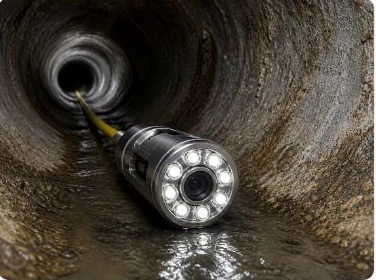
Waterproof pipe camera and inspection cable

How CCTV Sewer Inspection Works

CCTV stands for closed-circuit television.

In sewer inspection, it refers to equipment that sends video images from inside the pipe to a monitor.

A technician guides the camera through accessible piping and observes the interior surfaces, joints, and visible obstructions.

The equipment may also record footage for later review.

Unlike excavation, the process usually does not require exposing the full sewer pipe.

However, a camera can only inspect sections that the equipment can safely reach.

What Equipment Is Used?

Residential sewer inspections commonly use a flexible pushrod camera.

The system may include a waterproof camera head, built-in lighting, cable reel, display monitor, and recording equipment.

Some cameras have transmitters that work with compatible surface locating equipment.

Larger commercial sewer systems may require different equipment, including remotely operated camera crawlers.

The equipment selected depends on pipe size, access, and inspection requirements.

Is a Sewer Camera Inspection the Same as Drain Cleaning?

No. These services have different purposes.

Drain cleaning attempts to remove an obstruction and restore wastewater flow.

A sewer camera inspection provides visual information about the accessible pipe interior.

A camera may reveal why a blockage keeps returning, but it does not automatically clear the obstruction.

In some situations, cleaning is necessary before the camera can obtain a useful view.

When Should You Consider a Sewer Camera Inspection?

A sewer inspection can be useful when drainage problems affect several fixtures, repeatedly return after cleaning, or suggest that underground piping may be damaged.

An inspection may also be considered before major sewer work or during a property purchase.

Recurring Sewer Line Blockages

A sewer line that repeatedly clogs may have an underlying defect that traps waste.

For example, root intrusion, a displaced joint, or a low section of pipe can contribute to recurring restrictions.

Cleaning may restore flow temporarily without explaining why the problem keeps returning.

A camera inspection may reveal visible conditions that help guide the next step.

Multiple Slow Drains

When several plumbing fixtures drain slowly around the same time, the restriction may be located downstream from their individual connections.

A sewer camera can help investigate accessible sections of the shared drainage system.

However, the inspection should follow an assessment of the symptoms rather than assuming that all slow drains indicate a damaged sewer lateral.

Sewage Backups

Wastewater returning through lower fixtures can indicate a restriction in the building drain or sewer lateral.

If sewage is entering occupied spaces, stop using affected plumbing fixtures and keep people away from contaminated areas.

Once the immediate situation is addressed, camera inspection may help identify visible defects contributing to the backup.

For active contamination and urgent safety guidance, see our emergency sewer repair information.

Sewer Odors Without an Obvious Cause

Persistent sewer odors can result from several conditions, including dry traps, venting problems, drain blockages, or defective piping.

A camera may help examine an accessible pipe for visible problems.

Smell alone does not confirm an underground sewer leak.

Before Major Sewer Repairs

A camera inspection may help establish whether a pipe requires cleaning, localized repair, rehabilitation, or replacement.

For example, one cracked joint may justify a different repair scope than multiple severely deteriorated sections.

Understanding the condition can help avoid unnecessary excavation.

VISIBLE PIPE FINDINGS

What Problems Can a Sewer Camera Reveal?

A camera can provide detailed visual evidence of accessible interior pipe conditions.

The quality of the findings depends on visibility, pipe access, equipment, and how the images are interpreted.

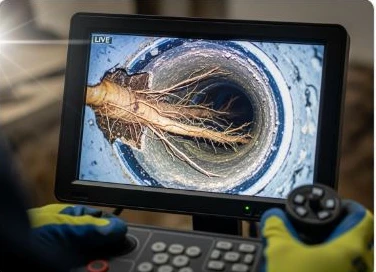
Video inspection showing a pipe obstruction

Tree Roots Inside Sewer Pipes

Roots may enter through cracks, faulty joints, or other openings.

Inside the pipe, they can form masses that trap debris and restrict wastewater flow.

Camera footage may show roots growing through a visible opening.

However, the inspection should also consider the condition of the surrounding pipe before deciding whether root removal alone is sufficient.

Read more about tree roots in sewer lines and the difference between clearing roots and correcting the entry point.

Cracks and Fractures

A sewer camera may reveal visible cracks along the pipe wall or around joints.

Some cracks are isolated, while others occur alongside broader deterioration.

A visible fracture does not automatically mean the entire sewer line must be replaced.

Its location, extent, and surrounding pipe condition matter.

Displaced or Separated Pipe Joints

Underground sewer pipes are connected through joints or approved fittings.

Ground movement, deterioration, or installation problems can cause certain connections to become displaced.

Camera footage may show a noticeable offset or gap.

These defects can affect wastewater flow and may allow roots or surrounding material to enter the line.

Corrosion and Internal Deterioration

Certain pipe materials can experience corrosion or surface deterioration over time.

A camera may reveal rough internal surfaces, deposits, holes, or other visible signs of deterioration.

However, it cannot directly measure every aspect of remaining wall thickness or structural strength.

Additional assessment may be necessary before major repair decisions are made.

Standing Water and Pipe Bellies

Standing water inside a gravity sewer pipe can suggest a low section or another drainage condition.

A belly is an area where the pipe has sagged or has insufficient slope.

The significance depends on the amount of water, pipe geometry, and other observations.

A camera alone may not provide a complete measurement of pipe grade.

Grease, Debris, and Other Obstructions

A camera may show accumulated grease, foreign materials, or other debris restricting wastewater flow.

When a blockage prevents the equipment from passing, the inspection may need to stop until the obstruction can be safely addressed.

The findings help distinguish a visible obstruction from an obvious structural defect.

Severely Damaged or Collapsed Sections

In some cases, a camera may reveal a severely deformed or broken section.

A major collapse can prevent the camera from traveling farther.

The technician should explain what was actually observed and what remains unknown beyond the obstruction.
KNOW THE LIMITS

What a Sewer Camera Inspection Cannot Confirm

A sewer camera is a valuable diagnostic tool, but it is not a complete test of every condition affecting underground piping.

Understanding its limitations helps prevent incorrect conclusions.

A Camera Cannot Prove Every Sewer Leak

A camera may reveal cracks, separated joints, or visible defects that could permit wastewater leakage.

However, it does not necessarily establish that wastewater is escaping at that location.

Some leaks are difficult to confirm visually.

Additional testing or investigation may be needed.

Our sewer leak detection guide explains why visible pipe defects and confirmed leakage are not always the same finding.

It Cannot Show Every External Condition

A camera normally examines the pipe interior.

It does not directly show the soil surrounding the line, the condition of underground bedding, or every outside utility.

A pipe may appear relatively clear inside while other underground conditions remain unknown.

It May Not Inspect a Blocked Section

Roots, debris, collapse, or another obstruction can stop a camera from advancing.

The equipment should not be forced through an unsuitable restriction.

Cleaning or another access method may be needed before further inspection.

It Does Not Guarantee the Pipe Is Structurally Sound

A camera can reveal visible defects, but it cannot reliably establish the full remaining structural strength of every pipe wall.

An apparently clear view does not prove that the pipe has no hidden defects.

The inspection findings should be interpreted within the limits of the equipment and observed conditions.

A DIAGNOSIS-LED APPROACH

How a Professional Sewer Camera Inspection Is Performed

A useful inspection begins by understanding the drainage problem and establishing suitable access.

The exact procedure depends on the building layout and pipe condition.

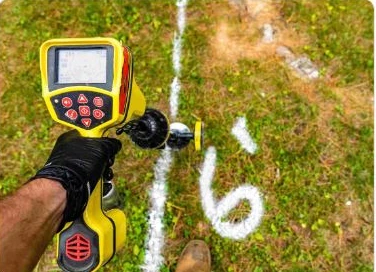
Technician using equipment to locate underground pipe conditions
01

Step 1 — Discuss the Symptoms

The technician may ask which fixtures are affected, how often backups occur, and whether previous drain cleaning helped.

Information about earlier repairs and pipe materials can be useful.

The goal is to identify which part of the drainage system should be investigated.

02

Step 2 — Find a Suitable Access Point

A sewer cleanout is commonly used to access underground drain or sewer piping.

Its location and condition can affect the inspection.

Some properties have easily accessible cleanouts, while others require additional preparation or an alternate entry point.

03

Step 3 — Check Whether Cleaning Is Needed

A heavily obstructed pipe may not allow the camera to travel far enough for a useful inspection.

In those situations, appropriate cleaning may be considered first.

The cleaning method should account for the existing pipe condition.

04

Step 4 — Insert and Guide the Camera

The camera is advanced through accessible sections of the pipe.

The technician observes the video display and looks for visible restrictions, damage, and unusual pipe conditions.

Where equipment supports it, footage may be recorded for later review.

05

Step 5 — Identify and Locate Significant Findings

If a visible defect is found, compatible locating equipment may help estimate its position above ground.

Distance measurements and locating signals can support repair planning, but their accuracy depends on the equipment, pipe route, and site conditions.

06

Step 6 — Review the Results

The customer should receive an explanation of significant findings.

A useful discussion identifies what was observed, where it was seen, and what remains uncertain.

Camera footage should support the recommendation rather than replace a clear explanation.

07

Step 7 — Discuss Appropriate Next Steps

Depending on the findings, possible next steps may include cleaning, monitoring, additional testing, localized repair, pipe lining, or replacement.

No repair method should be selected solely because it is convenient to sell.

☎

Call to Discuss Sewer Camera Inspection Findings: +1 (321) 425-1571

Ask what was observed, where it was seen, and what remains uncertain before approving further work.

Contact Us →
BEFORE YOU BUY

Sewer Camera Inspection Before Buying a Home in Irvine

A property purchase can involve significant financial decisions, and underground sewer condition may not be obvious during a standard walkthrough.

A separate sewer inspection may provide additional information about accessible drainage piping.

Why Buyers Consider Sewer Inspections

A sewer lateral may have defects even when plumbing fixtures appear to drain normally during a short visit.

A camera may reveal visible root intrusion, displaced joints, cracking, or other conditions that deserve evaluation.

The inspection may help buyers ask more informed questions before purchasing.

What About Older Homes?

Some older properties have sewer materials that differ from those in newer construction.

However, age alone does not establish whether a line is damaged.

Previous replacements, additions, or repairs may also affect the system.

Property-specific inspection findings are more meaningful than assumptions based on the construction date.

Can a Sewer Inspection Guarantee There Are No Problems?

No. A camera can inspect only accessible sections and visible internal conditions.

A blocked section, inaccessible branch, submerged surface, or hidden external problem may remain unexamined.

The report should identify any limitations.

Should Buyers Ask for Inspection Footage?

Where recordings are available, buyers may find it useful to request the relevant footage and an explanation of significant findings.

This can help when obtaining additional opinions or discussing possible repairs.

The inspection should clarify which pipe sections were actually examined.

EVIDENCE BEFORE WORK

Sewer Camera Inspection Before Repair or Replacement

A professional inspection may help avoid treating an entire underground sewer line as failed without adequate evidence.

It can also reveal whether damage extends beyond one small section.

Before Localized Sewer Repair

A camera may help locate an isolated crack, root intrusion point, or displaced joint.

That information can support a targeted repair plan when the surrounding pipe remains suitable.

Before Sewer Pipe Lining

Internal pipe rehabilitation requires an understanding of the existing host pipe.

Camera inspection can help assess visible condition, geometry, and access.

It does not eliminate the need for other method-specific evaluations.

Before Complete Sewer Replacement

A replacement recommendation should be supported by an assessment of the affected pipe.

If several serious defects are present, replacement may be justified.

Where damage is isolated, the customer may want to discuss whether a limited repair is appropriate.

For more information, see our sewer line replacement guide.

TAILORED TO THE PROPERTY

Residential and Commercial Camera Inspections

The inspection goals may be similar, but different properties can require different equipment and access arrangements.

Single-Family Homes

A residential inspection may examine accessible parts of the sewer lateral connecting the building to the receiving system.

The location of cleanouts and the pipe route influence how far the equipment can travel.

Townhouses and HOA Properties

Some shared developments have sewer piping serving multiple units.

Inspection planning should clarify which pipe is being examined and who is responsible for authorizing access.

Shared connections can make interpretation more complicated.

Commercial Buildings

Commercial drainage systems may include longer pipe runs, multiple branches, and different pipe sizes.

A larger camera system or crawler may be needed for some applications.

Property managers should consider access, wastewater use, tenant activities, and operating hours when planning an inspection.

Sewer Camera Inspection Cost in Irvine, CA

Camera inspection pricing depends on the property's drainage layout and the work needed to obtain useful findings.

A short inspection through an accessible cleanout differs from investigating a blocked or difficult-to-access sewer system.

Learn More About Inspection Cost →
⚙

Access to the Sewer LineAn accessible cleanout can simplify the inspection.

▣

Length and Diameter of PipeLonger or larger systems may need different equipment.

≋

Cleaning Before InspectionDebris or roots may require cleaning first.

◎

Locating Underground DefectsSurface locating equipment may add to the work.

▤

Recording and ReportingFootage, photos, or a written explanation.

?

Additional TestingFurther investigation if findings are inconclusive.

IRVINE SEWER LINE GUIDE

Understanding Sewer Camera Inspection Costs

Access to the Sewer Line

An accessible cleanout can simplify the inspection.

If an alternate access point is required, the scope may change.

Length and Diameter of Pipe

Longer or larger systems may need different equipment and more inspection time.

The number of sections being examined also affects the work.

Cleaning Before Inspection

A pipe filled with debris or roots may require cleaning before useful footage can be obtained.

Cleaning and inspection may be separate services.

The proposed scope should clarify what is included.

Locating Underground Defects

Using compatible surface locating equipment may add to the work.

The contractor should explain whether locating is included or charged separately.

Recording and Reporting

Some services include video footage, photographs, or a written explanation.

Others may provide only a verbal review unless additional documentation is requested.

Ask what records will be available after the inspection.

Additional Testing

If the findings are inconclusive, another method of investigation may be recommended.

A camera inspection should not be represented as a complete leak test when the evidence does not support that conclusion.

☎

Call to Discuss Sewer Camera Inspection Costs: +1 (321) 425-1571

Ask what is included in the proposed scope before scheduling.

Contact Us →
PROPERTY-SPECIFIC PLANNING

Irvine Sewer Laterals and Local Property Considerations

Properties in Irvine may have different underground sewer routes, materials, cleanout locations, and ownership arrangements.

Understanding the Sewer Lateral

A sewer lateral carries wastewater from the building toward the receiving sewer system.

Its location may extend beneath landscaped areas, driveways, or other features.

The inspection should identify the section being examined rather than assuming the entire lateral was accessible.

Sewer Pipe Location and Responsibility

Responsibility for repair may depend on utility rules, ownership records, easements, HOA documents, and the exact damaged section.

A camera inspection can provide information about pipe condition, but it does not establish legal ownership.

Confirm responsibility with the appropriate authority before authorizing major work.

Irvine Plumbing Permits

A standalone visual camera inspection is different from physically repairing or replacing sewer piping.

When follow-up work includes covered plumbing repairs or alterations, the applicable permits and inspections should be confirmed with the City of Irvine or other responsible jurisdiction.

Neighborhood and Construction Differences

Properties in areas such as Northwood, Woodbridge, Westpark, Turtle Rock, and other Irvine communities may have different sewer access arrangements.

The age of a neighborhood does not determine the exact condition of every pipe.

A property-specific inspection provides more useful information than generalized assumptions.

BEFORE YOU SCHEDULE

Questions to Ask About a Sewer Camera Inspection

Before scheduling an inspection, ask what portion of the drainage system the technician expects to examine.

Clarify whether cleaning is included, whether an accessible cleanout is needed, and whether recording equipment will be used.

Ask if the service includes locating significant defects above ground.

It is also reasonable to ask how uncertain findings will be explained.

If repair is recommended, request a clear description of the damage and why the proposed method is appropriate.

For substantial underground work, verify the contractor's relevant licensing and discuss permits and restoration separately.

Sewer Camera Inspection FAQs

Have a different question? Contact Us →
Can a sewer camera find a broken underground pipe?

A sewer camera can reveal some visible pipe breaks, cracks, separated joints, and other internal defects.

However, its view depends on pipe access, visibility, and whether the equipment can travel through the affected section.

Additional testing or excavation may be needed when the suspected damage cannot be confirmed visually.

Can a camera inspection locate a sewer blockage?

Often, it can help identify the visible location and nature of an obstruction in an accessible pipe.

Some systems can also work with surface locating equipment to estimate where the camera head is underground.

A blockage may prevent the camera from traveling beyond that point, so cleaning may be required for a more complete inspection.

Will a sewer camera inspection damage my pipes?

A properly selected camera used in suitable piping is intended for visual inspection, not cutting or removing pipe material.

However, badly deteriorated or obstructed pipes may require special care.

The technician should select appropriate equipment and avoid forcing it through unsuitable restrictions.

Do I need to clean the sewer line before a camera inspection?

Not always. A camera may travel through a reasonably clear pipe without prior cleaning.

If roots, debris, or other obstructions block the view or prevent the camera from advancing, cleaning may be recommended.

The technician should explain whether cleaning is necessary and whether it is included in the proposed work.

Can a sewer camera detect every underground leak?

No. A camera can reveal visible cracks, joint defects, and other conditions that may be associated with leakage.

It cannot confirm every leak or show all external pipe conditions.

Additional testing or investigation may be necessary when leak confirmation is important.

Is a sewer camera inspection useful before buying a house?

It can be. A camera inspection may reveal visible sewer conditions that are not apparent during ordinary property viewing.

It is especially useful when evaluating recurring drainage concerns or an uncertain sewer maintenance history.

The inspection should clearly state the sections examined and any limitations.

Can a sewer camera identify tree roots in a pipe?

Yes, when roots are visible inside an accessible section.

The footage may show root masses entering through cracks or damaged joints.

However, the camera does not always establish the full condition of the surrounding pipe.

Further evaluation may be appropriate before choosing between cleaning and physical repair.

Can a sewer camera tell whether a pipe needs replacement?

A camera can provide useful evidence about cracks, root intrusion, severe deterioration, collapse, or other visible defects.

It does not automatically determine the correct repair.

Replacement decisions should also consider structural requirements, pipe location, alignment, access, and the feasibility of other solutions.

How long does a sewer camera inspection take?

The duration depends on access, pipe length, obstructions, equipment, and whether cleaning or locating work is needed.

A relatively clear and accessible residential line may require less time than a larger or obstructed commercial system.

A project-specific estimate is more useful than a guaranteed inspection duration.

What should I receive after a sewer camera inspection?

Ask for an understandable explanation of significant findings and which pipe sections were examined.

Where available, footage, photographs, distance readings, or a written report can help support later decisions.

The results should also identify important limitations, especially areas the camera could not inspect.

Call About Sewer Camera Inspection in Irvine, CA

A sewer camera inspection may help reveal visible underground pipe conditions before excavation or major repair decisions are made.

Whether you're dealing with recurring blockages, tree root intrusion, suspected structural damage, or questions about a property's sewer lateral, understanding the condition of the pipe is a useful starting point.

The right next step may be cleaning, additional investigation, localized repair, rehabilitation, or replacement.

Call About a Sewer Camera Inspection: +1 (321) 425-1571

Irvine, California — Sewer Video Inspection and Underground Pipe Condition Information

☎   Call Now +1 (321) 425-1571Schedule an Inspection
☎   Call Now +1 (321) 425-1571