WHY PIPES FAILWhat Causes Underground Sewer Pipes to Collapse?
Sewer collapse can result from material deterioration, external loading, poor support, or long-term movement around the pipe.
The exact cause matters because it may affect the replacement method and future installation requirements.
◈
Advanced Pipe Deterioration
Some pipe materials lose structural strength through deterioration over time.
For example, severe corrosion can weaken portions of cast iron piping.
Clay pipes may suffer fractures or joint failure.
However, pipe age alone does not establish collapse.
The condition of the individual pipe must be evaluated.
↔
Ground Movement and Settlement
Underground sewer pipes rely on suitable soil support.
Uneven settlement may cause sections to shift, crack, or lose alignment.
In serious circumstances, the resulting stress can contribute to structural failure.
A repair may need to address the surrounding support conditions rather than simply replacing the broken section.
▣
Poor Pipe Bedding
Improper bedding or insufficient support can place uneven loads on buried piping.
Over time, these conditions may contribute to cracking or deformation.
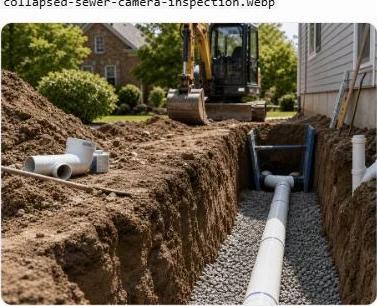
When a collapsed section is replaced, suitable bedding and backfill are important parts of the installation.
▲
External Loads
Heavy vehicles, construction activity, excavation, or other external forces may damage underground pipes under certain conditions.
The risk depends on pipe depth, material, installation, and soil support.
A collapsed section near recent construction should be evaluated in the context of the actual site history.
⇋
Severe Joint Displacement
An underground joint may move enough to create a major offset.
Although an offset is not necessarily a collapse, significant displacement can block flow and contribute to additional damage.
The repair decision should be based on the observed condition rather than using the terms interchangeably.
♧
Long-Term Root Intrusion and Existing Damage
Tree roots commonly enter through existing cracks or defective joints.
Growth inside the line may trap waste and aggravate damaged sections.
However, finding roots does not automatically mean they caused the pipe collapse.
Our tree roots in sewer lines guide explains how root intrusion can contribute to recurring sewer problems.